
screw-in column for rotary-indexer
The Screw-In Column: Stable Support for Structures on Rotary Indexing Tables
Wagner pneumatic rotary indexing tables convert a linear piston rod movement into a rotary motion of the plate via a pinion.
With various divisions or rotation directions, they find diverse applications in workpiece automation.
Those integrating a pneumatic rotary indexing table into a system often face the same challenge: Where should sensors, cameras, or mechanical stops that must not rotate with the plate be mounted? Friedemann Wagner's solution is the screw-in column.
The Problem: Rotating Cables and Unstable Mounts
During operation, the plate of a rotary indexing table rotates between the locks. If you want to process a component in the center or place other units (measuring technology, camera, etc.), you would have to extend mounts over the table from the outside (so-called "gallows"). This is often:
- Unstable: Vibrations impair measurement accuracy.
- Space-consuming: Accessibility to the system is restricted.
-
Complex: Cables must be tediously routed around the rotation area.
The Solution: Utilizing the Fixed Central Bore
The RSE-6 and RSE-9 rotary indexing units feature a central bore. The specially manufactured screw-in column can be fixed directly into this bore within the housing.
The ingenious thing about it: The indexing plate rotates around the column, while the column itself remains absolutely rigid and firmly connected to the housing. This allows valuable installation space to be used efficiently and quickly.
The screw-in column, as an accessory product, thus provides a central tripod for additional attachments when needed. This allows the design team to compactly and easily attach further elements above the rotating table surface.
Your Advantages with the Wagner Screw-In Column
- Maximum Stability: Since the column is screwed directly into the solid housing (fit + threaded ring), it offers a vibration-free base for camera systems or measuring technology.
- Central Cable Routing: Use the interior of the column to route cables protected upwards.
- Compact Design: Eliminate the need for external mounting structures. Your setups remain within the footprint of the rotary indexing table.
-
Flexibility: The column can be used for our modular system or your special fixtures: additional pneumatic modules that act directly on the workpieces on the plate can be attached via a clamping block (accessory).
Practical Application Examples
- Sensor holder: Mounting of a proximity switch for part inspection at the center.
- Mechanical hold: Fixing of additional processing modules for assembly operations.
- Camera inspection: Positioning of a smart cam for 360° inspection of components.
Conclusion: More Than Just an Accessory
The screw-in column transforms a mere rotary drive into a fully integrated processing station. It is the indispensable accessory for anyone seeking precision and order in their automation solution.
💡 Expert Tip
Order the screw-in column directly - or retrofit it - to match your RSE-6 or RSE-9 to guarantee a perfect fit and immediate readiness for use.
Exemplary Setup
See for yourself, for example, at our trade fair appearances, the possibilities of compactly, quickly, easily, and effortlessly mounting various handling units above a rotary indexing table. As shown in the image on the right, a horizontal linear unit LSK-4 and a vertical linear unit LSM-3 with a directly mounted mini-gripper PGM-29 are attached to the screw-in column of the RSE-6 rotary indexing table via a clamping block.
The Task: Workpiece Processing on the Footprint of the Rotary Indexing Table
An RSE-9 rotary indexing table, left-hand rotating, with 4-division and pneumatic damping, is "equipped" with the workpiece at position 1, and removal is to take place at position 4. However, the workpiece - after successful "pressing in" processing at position 2 - is to be rotated by 90° at position 3.
The Solution: Screw-in Column as a Tripod for Attachments
A lifting unit HEK-6 can be mounted directly on the screw-in column via a clamping angle and adapter element. The pressing-in takes place at this position 2.
The plate continues to move after being actuated.
A linear unit LSK-6, whose stroke acts in the Z-direction, is fixed to the clamping block screw-in column mounted above. A swivel drive SE-4 (adjustable 0-190°) with a parallel gripper PGM-82 is mounted on the front plate of the linear unit - top-down.
The swivel drive itself has an air passage to supply the gripper through the rotating shaft of the swivel unit! So this unit moves down to position 3, grips the workpiece and turns it according to the task!
💡 Tip for Designers
Accompanying the description above, you will find a 3D image below or here in detail an image and list of the products named in the 3D drawing.
Download 3D data of the example
You can immediately see what our modular system enables. As shown here in the blog, grid dimensions and centering rings (fits) form the basis for quick joining without drilling.
Note: Since the screw-in column is designed as a hollow shaft, the application described above can be supplied with energy through the center.
💡Tip for Installation + Retrofitting
The center of the pneumatic rotary indexing tables RSE-6 and RSE-9 has a fixed central bore. This is covered with a plastic cap that can be pushed out from below.
You can find the data for the screw-in columns ES-6 and ES-9 here in the datasheet - both are designed as a fit at the base. They are simply pushed through the bore and secured from below with a threaded ring.
This brings another advantage: the entire setup for installation and maintenance is movable! The tripod is not permanently installed in the application but acts directly on the rotary indexing table.
Interested? Faster than reading - here's a short video with the screw-in column:


Read more
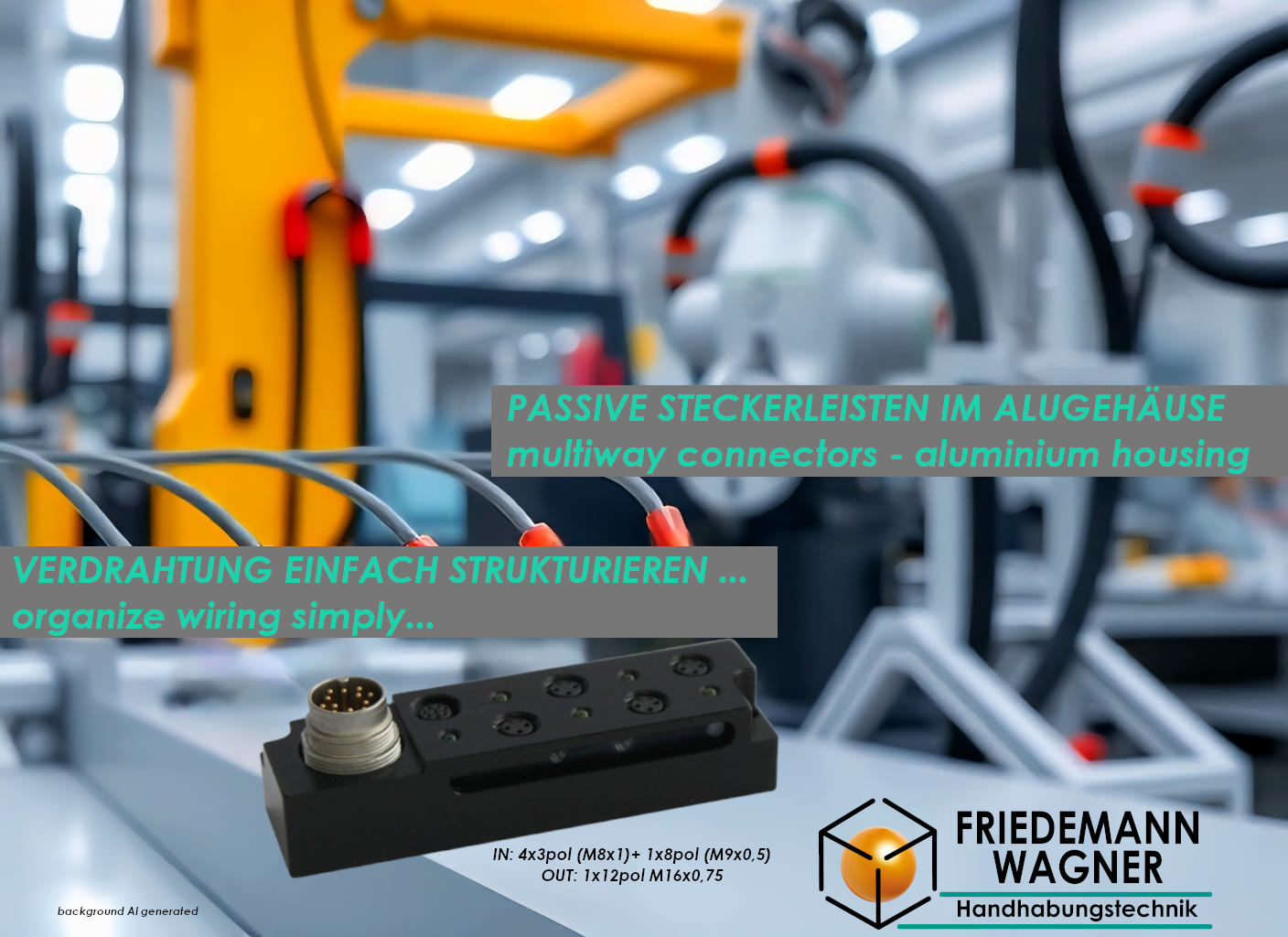
Connector strip for structured wiring
Quickly and easily add structure to loose cable ends!
Read more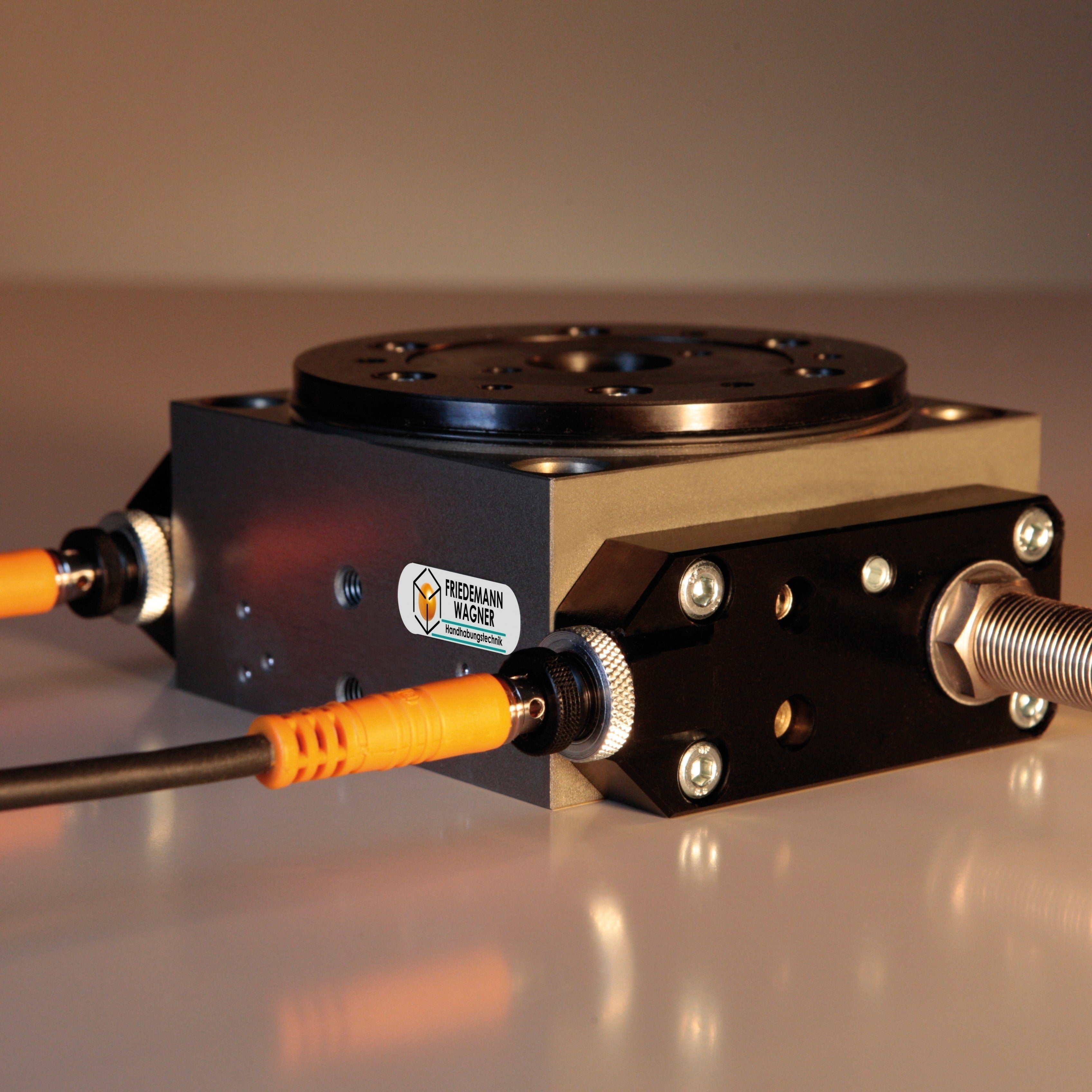
Characteristics rotary indexer RSE-3
tiny pneumatic rotary indexing table by Wagner -for small workpieces
Read more
Watch animations