
Pneumatic lifting units enable fast automation cycles for lifting and lowering workpieces.
These are essentially pneumatic linear units whose design, rigidity, and material selection
are specifically engineered for precise vertical movements in automation applications. For long service life and reliability under demanding cycle conditions,
only short strokes are usually required in automation.
An example is a minimal lifting required for subsequent gripping of a workpiece.
Lifting units from the manufacturer Friedemann Wagner GmbH are available
"of the shelf" in stroke lengths from 10 mm to 100 mm in various sizes.
The stroke can be finely adjusted using stop screws or threaded rods.
Since lifting units are capable of high speeds, these modules are made of high-quality materials and, above all, are very robustly constructed. Horizontal operation is conceivable – however, it should be considered whether a linear unit is a more cost-effective alternative, as the rigidity of a lifting unit is not absolutely necessary for horizontal operation.
Physically, the lowering movement always occurs in the direction of gravity. For precise positioning without bouncing and for a long service life, the use of external throttles and hydraulic dampers is recommended.
All lifting units from Friedemann Wagner GmbH can be ordered from stock with or without hydraulic dampers. Shock absorbers can also be purchased and retrofitted later if required.
The lifting units can be equipped with sensors for end-of-stroke detection.
The pneumatic lifting modules are easily joined using grid spacing and centering rings (fits). This enables quick installation and commissioning.
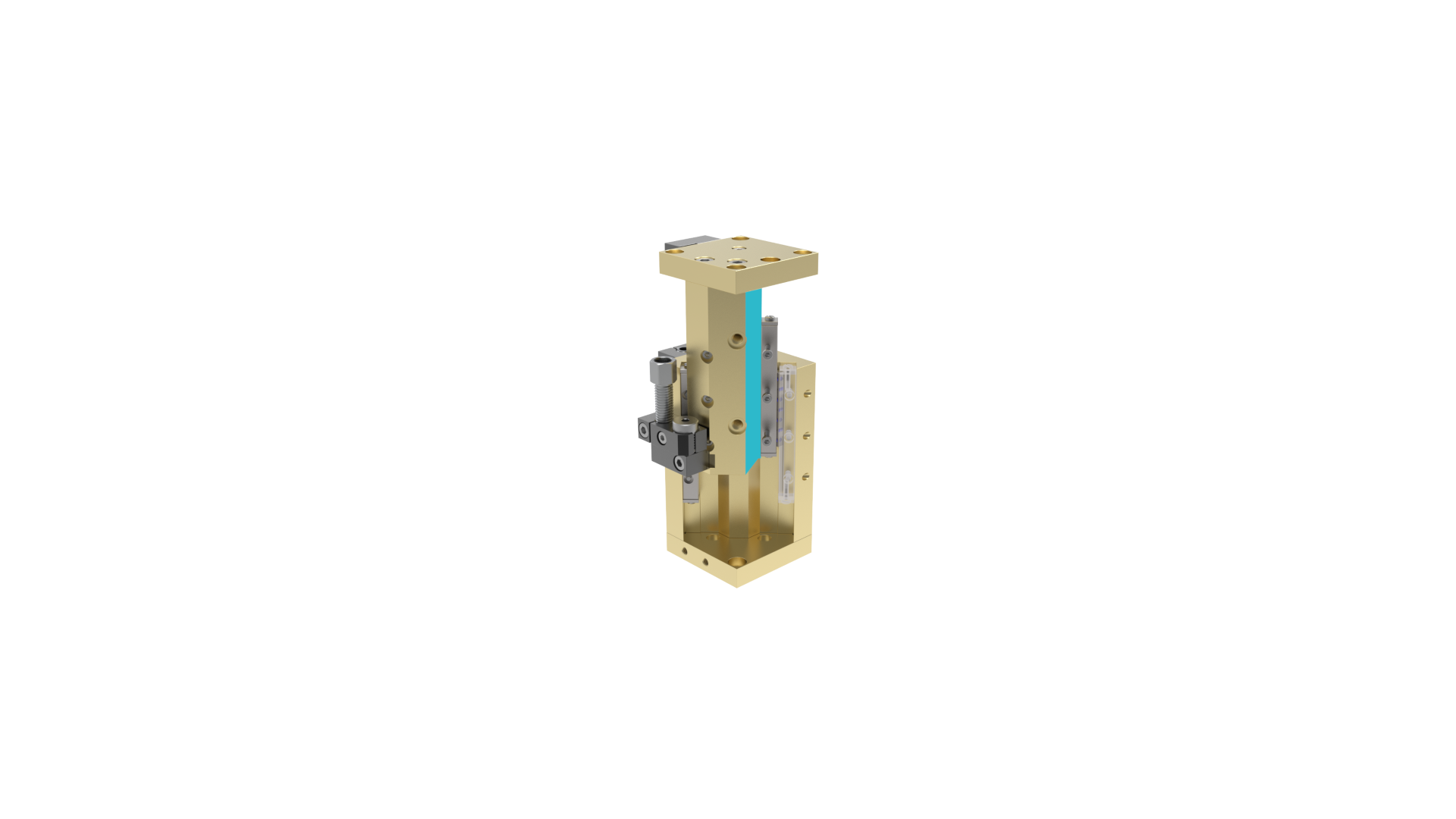
Lifting units of the HE-series from Friedemann Wagner are equipped with linear bushings. The HEK-series was developed for special applications requiring high precision. As can be seen in the following animation, crossed roller guides are installed diagonally to the base.
These are used to absorb high torques during the lifting process.
Animation: Funktionsprinzip der Hubeinheiten mit Kreuzrollenführung
DOWNLOADS

Youtube
Watch animations