
Swivel Units by Friedemann Wagner – a different construction!
The Wagner Principle: Why our Rotary Actuators are Technically a Decisive Step Ahead
In the world of pneumatic rotary actuators, there are many standard solutions. But standard often means compromises in precision. At Friedemann Wagner, we pursue a different approach to achieve maximum accuracy and longevity. Learn here how the design of our rotary units (SE series) makes your processes safer.
The Subtle Difference in Mechanics
Most rotary actuators on the market use simple pinion-and-rack systems. Without external stops, the stop is made directly on the rack. These solutions are inexpensive and can be built compactly. However, they have significant disadvantages:
- they stress the actuator
- have only half the torque in the end position and
- are affected by the mechanical play of the actuator in the end position.
Our approach is based on a high-strength aluminum housing, with an external stop as an integral part of the milled housing. This optimized approach relieves the gearing and ensures that the end position is precisely positioned even after millions of cycles. With full torque in the end position - the most important position in the automation system!
The Graphic in Detail: Our Design Explained
In the following overview, you can see the core components that make our rotary units so unique. Please note the numbers in the graphic:
- The external stops of the rotary actuators offer high repeatability on annular surfaces and full torque in the end position. The gear is thus relieved and irrelevant for accuracy and positioning.
- Stop screws for stepless adjustment up to 190° (+/-95° around the center position). The adjustment of the rotation angle and the locking of the stop plate are done on the outside of the rotary actuator. The mounting for the stop screws is part of the high-strength, milled aluminum housing – thus eliminating fitting tolerances of mounted stops.
- Air and signal feed-throughs are available as variants and offer feed-through through the rotating rotary actuators. This ensures short paths for supplying the superstructures and avoids torsion.
- Patented system for mounting the proximity switch directly in the stop screw. The proximity switch can be determined in its switching point by screwing it in, thus allowing precise acknowledgement of the actual end position (see blog shock absorber failure monitoring in rotary actuators). By locking it (knurled nut), its position relative to the stop screw is always maintained – simplifying and saving time during installation.
- The racks are equipped with encoder magnets – so inexpensive magnetic field sensors can alternatively be used in the C-slots.
- All connections and interfering contours are on one side of the rotary actuator. Accessibility during installation/commissioning is significantly easier and more effective.
And: all other sides can be enclosed, saving valuable space. - Mounting for hydraulic dampers for high moments of inertia up to 64200 kgcm2.
- Grid dimension for precisely fitting, play-free centering system for mounting without drilling or pinning.
Why should you choose this "different approach"?
The answer lies in the economic efficiency of your overall system:
- Higher Repeatability: Your end position remains exactly where it should be.
- Lower Maintenance Costs: Due to the constructive design, adjustments/re-adjustments can be made from the outside.
- Longer Service Life: Thanks to the well-thought-out design, the forces on the stop screws are lower. The overall system is thus additionally relieved.
- Third Position: can be easily retrofitted as an additional module intermediate position (ZWP-SE).
Conclusion: Engineering from the manufacturer instead of "normal"
We build rotary units for designers who are not content with "good enough." Our approach is the answer to the increasing demands for precision and reliability in modern automation.
Flyer "Why Wagner Rotary Actuators"
🎥 Moving images of the inner workings of the SES-6 rotary unit:
Detecting shock absorber failure in pneumatic rotary units!


Read more

Your contact for Switzerland and Austria
You like to buy our products in Switzerland or Austria? We are pleased to announce, now having an experienced partner in this areas: Fa. Schlumpf Industrieprodukte GmbH .
Read more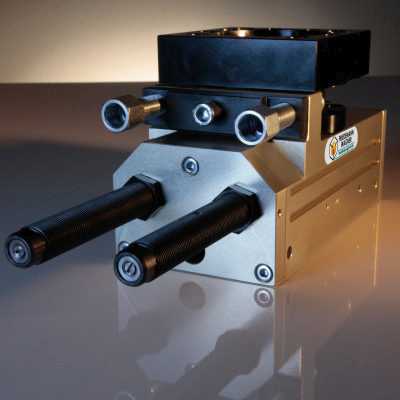
pneumatic vs. hydraulic/electric e.g. using a Swivel Unit
Just in case of rotation applications, pneumatics compared to electrics can have some benefits:
Read more
Watch animations