
Control of rotary indexers RSE-6 and RSE-9
Controlling Rotary Indexing Tables RSE-6 and RSE-9: Maximum Efficiency with Minimal Effort
In automation, less is often more. This is especially true for controlling pneumatic components. While many rotary indexing tables require complex valve groups, the RSE-6 and RSE-9 models from Friedemann Wagner rely on an ingenious principle: one-valve control. All Wagner RSE rotary indexing tables with a single direction of rotation are designed so that the drive and locking mechanism are controlled with one (1 piece) 3/2-, 4/2-, or 5/2-way valve. This helps save components, space, time, and money from the outset.
The Problem: Complexity in PLC Programming
Normally, with pneumatic drives, the forward and return stroke as well as the locking mechanism must be controlled and monitored separately. This means:
- Multiple valves for procurement and application.
- Complex tubing.
- More complex control in the PLC.
The Solution: The Wagner One-Valve Logic
All Wagner RSE rotary indexing tables with a single direction of rotation are designed so that the drive and locking mechanism are controlled with one (1 piece) 3/2-, 4/2-, or 5/2-way valve.
💡Did you know?
Internal air channels are designed such that the locking mechanism and drive are "coupled". For example, when the table is locked, the rack is automatically returned. This internal logic eliminates the risk of control errors; the mechanism only releases the stroke once the lock is disengaged.
How the Control Works in Practice:
Our assembly and operating instructions for rotary indexing tables RSE-6 and RSE-9 show two common connection patterns.
The legend refers to a 5/2-way valve with pneumatic return*, whose connection is applied to output "Y" (circuit symbol in image gallery).
- State 1: The table is locked and stable in its position (e.g., for processing or transferring the workpiece). The rack is in its home position.
-
State 2: After the workpiece has been processed, the valve is actuated, which releases the lock. The rack moves, and the table performs the rotation. When the rack reaches the end of its travel, the air pulse automatically locks the table, disconnects the rack from the drive, and allows it to retract.
The control air applied at Y is therefore used to reset the valve and thus saves a sensor and its complete system integration!
This simplification reduces the required number of outputs on your PLC!
Conversely, this explains why with the RSE-6 and RSE-9 rotary indexing units, only the locking mechanism is optionally queried (sensor available if required in the accessories ).
Technical Advantages at a Glance
When you integrate the RSE-6 or RSE-9 into your system, you benefit from:
- Lower hardware costs: A 5/2-way valve is sufficient.
- Faster commissioning: Less tubing, simpler program code.
- Higher operational reliability: Mechanical forced control simplifies operation and reduces sources of error.
- Simple query: The end positions can be conveniently monitored via standard proximity switches (M8).
Conclusion for Designers
The control of the RSE series is a prime example of efficient engineering. You save time in programming and costs in hardware, without compromising on precision.
💡Expert Tip:
If you have continuous "air applied" at Y, then A and B are swapped - the table does not lock: in this case, simply swap A and B.
Ideally, control the electrical side of the bistable valve only via a switching pulse.
💡Expert Tip:
Of course, you can also perform the control with a standard directional control valve, which you control via a timer or your "own" query of the workpiece position.
To avoid losing as much compressed air as possible, we recommend then closing the unused output "Y".
Alternatively, a standard pressure switch (G1/8") can be connected to output "Y" - this converts the pressure pulse into a signal for your PLC.
*Please contact us; we can offer you a suitable, pre-assembled 5/2-way valve with pneumatic return.
Animation "Rotary Indexing Table RSE-6 and RSE-9"


Read more
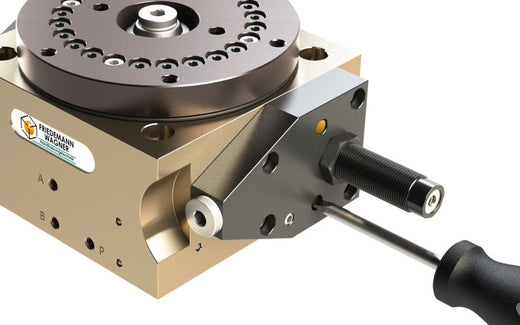
Choke in rotary indexing table
exhaust air throttle onboard ✓ no additional component to be bought or installed
Read more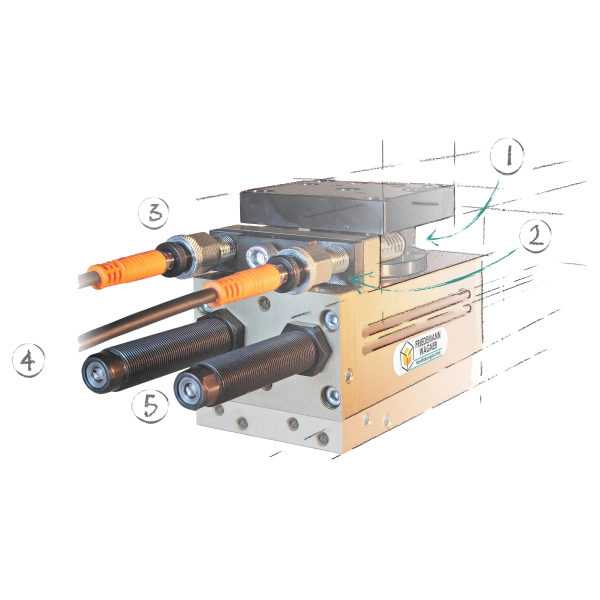
detection of defect shock absorbers in swivel units
Swivel units of Friedemann Wagner GmbH Handhabungstechnik have an external stop-system – enabling the user to detect a defect shock absorber in time.
Read more
Watch animations