
Gripper PGM sectional view – principle of construction
A Look Inside: The PGM Parallel Gripper Explained in Detail
Why is the PGM parallel gripper so durable, precise, and always self-centering? To answer this question, we need to look beneath the surface. In this article, we will analyze the cross-section of our compact powerhouse and explain why its mechanical design makes a decisive difference in your production.
The Core Component: The Deflection Mechanism
Inside the PGM, a deflection mechanism is at work. This mechanism converts the vertical movement of the piston into a synchronous, horizontal movement of the gripper jaws.
The Design of the PGM in Cross-Section
The cross-section on the right perfectly illustrates the quality features of Wagner grippers:
- Robust Housing: Made of high-strength aluminum, hard-anodized for minimal friction and maximum protection against wear.
- Precision Piston: Provides the necessary drive force – even at low operating pressure (operates at 2-8 bar).
-
Mechanical Guidance: The jaw guide, along with the deflection mechanism and the guide shafts, contributes to stable movement and the absorption of moments.
- Query Option: The housing features bores for direct mounting of sensors to reliably detect the "Open" or "Closed" position. From a size of PGM-60, C-slots are integrated (due to size).
💡Detailed: for Tech Enthusiasts
The pneumatically moved piston (1) is mounted in the guide element (2) and, by means of a hard-chrome-plated piston rod (3), transmits its movement directly to a guide cam, the so-called deflection mechanism (4) (material X45NiCrMo4).
The clamping jaws (5), on which the customer will later mount their fingers, are positively guided (6) in the central cam: the movement of the pneumatic piston is deflected for gripping or spreading via an incline. At the same time, the cam is guided in a groove (7) of the respective jaw. To absorb tilting moments, both jaws run on ground and hardened, stainless guide shafts (8).
This design principle is very compact, easy to maintain, and inevitably leads to a self-centering gripping system!
It is correct that dirt can enter the open PGM gripper – but it can also escape just as easily! This means that dust does not accumulate in the guides and cause them to jam or clog. Naturally, the piston rod runs in a sealing wiper, which is integrated into the guide cover (9).
For later operation, an open system means that the parallel gripper can be blown out and lubricated while installed.
In addition to the material selection of the components shown above, the high-strength, hard-anodized aluminum of the housing and jaws ensures longevity!
All variants have mounts for inductive sensors for querying (11). Through blind holes in the jaws, the sensitivity of the query can be adjusted so that the positions "open", "closed", and "gripped" can be confirmed.
💡Expert Tip: Mounting the Gripper and Fingers
All grippers are delivered with 6 centering rings. These h6 fits, with the corresponding bores (13), are used in pairs (diagonally) for mounting the fingers and the gripper housing.
Technical Details
- PGM variants are available with strokes from 2 mm to 15 mm per jaw.
- Repeatability is +/-0.02 mm.
- The maximum recommended workpiece weight, distributed across the sizes, is frictionally locked at 0.13 kg to 7.2 kg (piston diameter 10-63 mm).
- The length over both closed jaws for the smallest gripper is 29 mm (PGM-29), for PGM-140 it is 140 mm.
💡Expert Tip: For Small Workpieces
Technical data applies at 6 bar pressure, although the PGM can be operated between 2 and 8 bar. Especially for the tiny PGM-29, operation with less force can be attractive for very small workpieces. As usual, the gripping speeds can be adjusted via external throttles.
Why Designers Love the PGM
In automation, reliability is the most important currency. The PGM convinces with:
- Compactness: Ideal for use in automation and assembly cells.
- Easy Maintenance: Due to its open design, the gripper can be blown out and lubricated while installed.
- Robust: No matter the gripping task, the hard-anodized housing made of high-strength aluminum is durable and resistant.
- Self-Centering: The PGM parallel gripper, with its centrally designed construction principle, offers a repeatability of +/-0.02 mm.
- Construction Details: Simple solutions like gripping force safeguarding or an integrated groove are helpful in daily use.
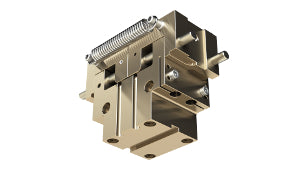
Groove on the mounting surface PGM
Conclusion: Quality is Seen from the Inside
A gripper is only as good as its mechanics. The cross-section of the PGM shows that at Friedemann Wagner, we make no compromises. Every detail is optimized for durability, repeatability, and reliability.
🎥 Moving Images of the PGM's Inner Workings:


Read more
Handling modules from manufacturer Friedemann Wagner since 40 years!
We are proud, being now 40 years part of the market - see our detailed company-history.
Read more
With our logo we were able to make a small contribution…
We are happy to have helped with a small donation!
Read more
Watch animations