
Rotary indexing table and moment of inertia
Moment of Inertia in Rotary Indexing Tables: How to Safely Design Your System.
The cycle time is set, the rotary indexing table chosen – but will the mechanics withstand the load over time? The answer lies in the moment of inertia J. If heavy superstructures or large diameters are to be moved, it takes more than just energy to move them. Enormous forces arise during stopping – the kinetic energy must be controlled to ensure safe locking.
In this guide, you will learn how to safely design your application and avoid costly failures.
Why is the moment of inertia so important?
The moment of inertia describes a body's resistance to a change in its rotational motion.
The inertial moment depends on the distribution of mass relative to the axis of rotation. Thus, shape, material (density), position, and especially the distance to the axis of rotation play a role. This applies to both acceleration and deceleration.
Imagine you have to stop a carousel by hand. The further out the people sit and/or the heavier they are, the more force you need.
With a rotary indexing table, it's exactly the same: A moment of inertia that is too high leads to:
- Lack of rotational acceleration.
- Insufficient deceleration.
- Positioning errors due to bouncing.
- Mechanical blockage during locking.
- Premature wear.
The golden formula for practical application
For the most common application – a circular plate (additional mass) – we use the basic physical formula: J = m x r²
Where:
- m = the mass of the superstructure in [kg]
- r = the radius in [m]
Further technical literature provides various calculation examples for bodies. Calculation tools are also often available online.
💡Important:
Since the radius is squared, a doubling of the diameter has a quadruple effect on the load.
Load Tables: The Load Limits of the RSE Series
To keep you from fumbling in the dark, we have defined maximum limit values for our rotary indexing units. These tables are your safety net for design. Please refer to the official datasheet of your model for the exact values:
!["Massenträgheitsmoment
moment of inertia
J[kgcm²]"
"Dämpfung
shock absorber"
"Rundschalttisch
rotary indexer" "Antriebsart
drive" "pneumatisch
pneumatic" "hydraulisch
hydraulic" "keine
none"
RSE-3 "pneumatisch
pneumatic" - 60 -
RSE-4 - 175 -
RSE-6 405 1540 -
RSE-9 2734 11000 -
RSE-6-M "manuell
manually" - - 20000*
* Betriebsanleitung beachten / see operating instructions](https://cdn.shopify.com/s/files/1/0898/3383/2788/files/Tabelle_Massentraegheitsmoment_J_RSE_Wagner.jpg?v=1771408279)
💡Expert Tips for Optimization
Usually, the workpiece is predefined. If your calculation shows that the moment of inertia is too high, you have several levers:
- Reduce mass: For example, use aluminum or plastics instead of steel for the indexing plate.
- Optimize the superstructures: for example, mill relief pockets into the indexing plate or optimize from a "solid disk" to a "spoked wheel".
- Adjust switching time: Throttling brings "calm" to the movement and allows locking without bouncing.
-
Adjust damping: For extreme loads, additional shock absorbers at the end stops should be adjusted (turn in or out, provide stronger dampers if necessary, provide additional dampers on the superstructure if necessary).
💡Plate Selection: What Effect Do Material, Diameter, and Shape Have!
Design of a plate * Assumption of load as 4-way division / 90°
| Plate, Material | Thickness | Diameter | Weight |
Moment of |
| Solid disc, Steel | 10mm | 200mm | 2.45kg | 122.5kgcm² |
| Solid disc, Steel | 10mm | 250mm | 3.83kg | 299.1kgcm² |
| Solid disc, Steel | 10mm | 300mm | 5.51kg | 620.3kgcm² |
| Solid disc, Alu | 10mm | 300mm | 1.91kg | 214.7kgcm² |
| Solid disc, PA6 GF15 | 10mm | 300mm | 0.87kg | 97.8kgcm² |
| Cross, Steel | 10mm | 300mm, W=25mm | 1.17kg | 88.4kgcm² |
💡Load: What Effect Do Distance and Position Have!
Workpiece, cylinder D= 30mm, length 100mm, solid material
| Material | Mass | Distance to Axis of Rotation |
J transverse to |
J longitudinal to Axis of Rotation |
| Steel | 0.55kg | 0mm (centric) | 4.91kgcm² | 0.62kgcm² |
| Steel | 0.55kg | 50mm | 18.7kgcm² | 14.4kgcm² |
| Steel | 0.55kg | 100mm | 60.1kgcm² | 55.8kgcm² |
| Steel | 0.55kg | 200mm | 225.4kgcm² | 221.2kgcm² |
| Steel | 0.55kg | 300mm | 501.1kgcm² | 496.8kgcm² |
💡Cost Factor
A lower moment of inertia may allow for a smaller rotary indexing table – saving costs and reducing space requirements.
Design Tip
Technical data and load diagrams can be found here:

Read more
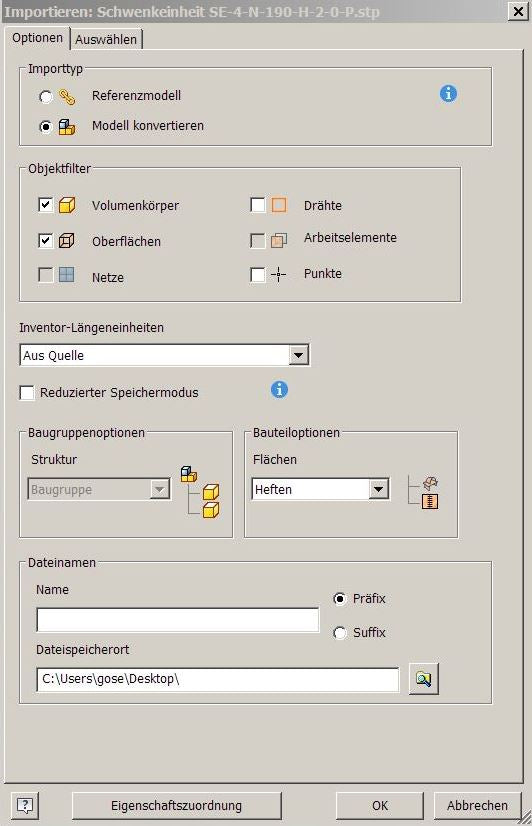
3D files available for download in the product finder
3D file for download Help with import.
Read more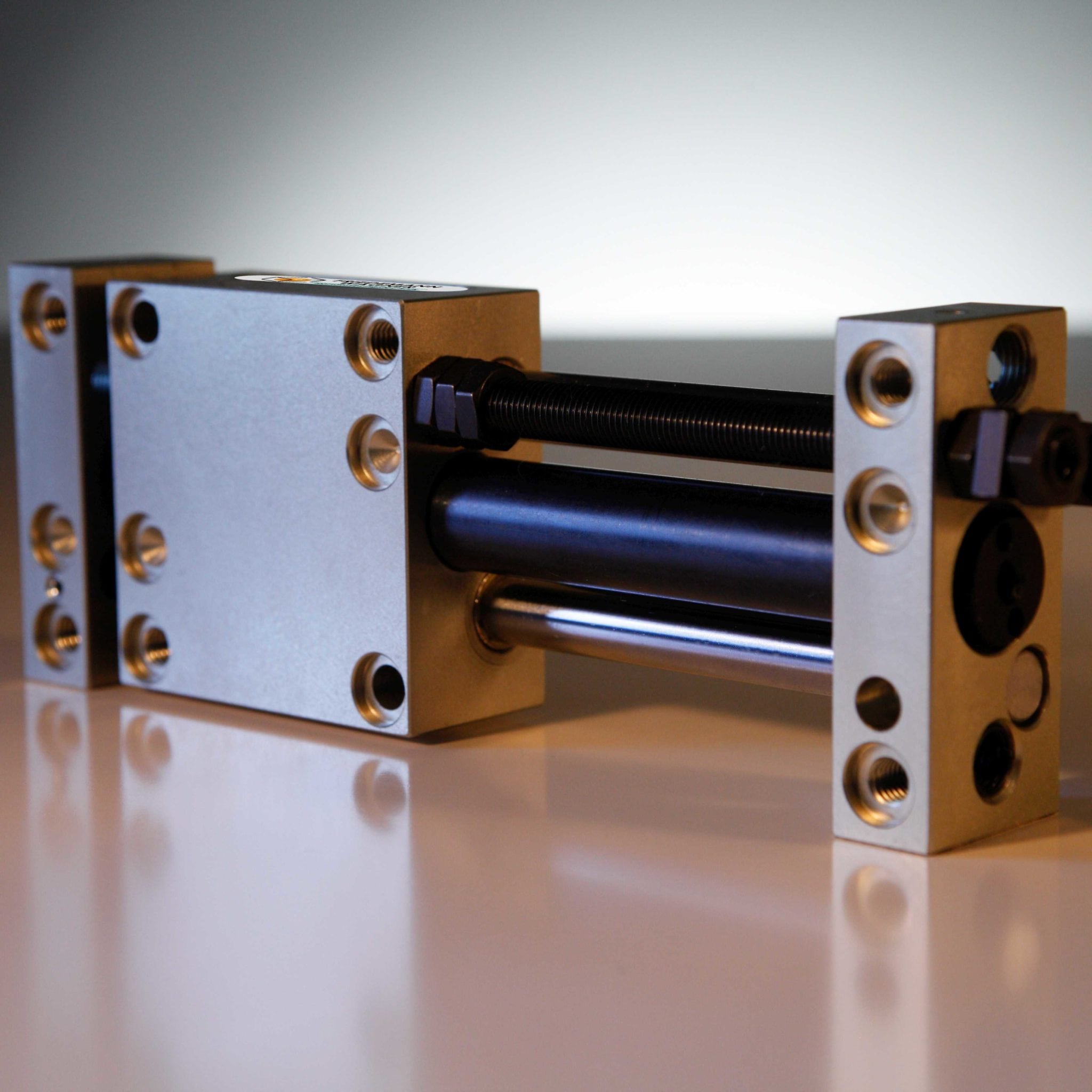

Watch animations