
Avoiding Overload in Manual Rotary Switch Panels
Avoiding Overloading in Manually Driven Rotary Indexing Tables: Causes and Solutions
As a manufacturer of manually driven rotary indexing tables, our practical experience shows that table diameters and setups in the field are too often at the very limit of the technical specifications or significantly exceed them. The direct consequences are shortened service life and unplanned production downtime.
Why do manual rotary indexing tables frequently become overloaded?
Unlike pneumatic or electric drives, where movements are precisely defined technically, the manual drive depends directly on the strength, momentum, physical ability, and daily form of the operating personnel alone.
Specifically, this means that when manually turning a rotary indexing table, the rotational speed and angular momentum depend heavily on the operator, the respective shift, and the handling.
- Varying end-position loading: The mechanical load – especially at the end position – fluctuates greatly and negatively affects the stability of the automation.
- Moment of inertia: Excessive masses (table and fixtures) place excessive strain on locking and stop mechanisms, which can lead to jamming or mechanical failure.
Damage pattern: How can you recognize overloading?
Experience shows that indexing pins and index pins are particularly severely affected.
- These components are available as spare parts and can be replaced using the RSE-6-M operating instructions and manual expertise.
- Nevertheless, unnecessary production downtime and high maintenance costs remain the result.
Background knowledge for designers and users
The manual rotary indexing table (our model RSE-6-M) is designed with a high-performance 4-point bearing whose preload determines the rotational resistance. During assembly, the bearing is adjusted so that the technical data are precisely met in accordance with the product specification – validated in extensive tests.
You can also find a note on this fact in the RSE-6-M operating instructions under the heading "disassembly of indexing plate".
In addition, we indicate the permissible loads and recommended operating times in detail in our technical documents, brochures, and operating instructions.
Design tips for optimization
Despite all guidelines, practice shows that applications are often complex, setups are larger, and human factors (shift work, piecework, operator physical ability) come into play. Even the positioning of the handles influences the mechanical end-position loading through lever laws and angles!
We therefore recommend checking and optimizing the following factors:
- Plate design: Size, thickness, material, and design of the rotary plate.
- Workpiece fixtures: Weight, quantity, and positioning on the table.
- Operating concept: Arrangement and ergonomic positioning of the turning handles for the personnel.
The solution for critical loading: The brake roller
For manually operated rotary tables, in cases of high stress, we recommend additionally a brake roller outside the rotary plate.
How the brake roller works
The brake roller is a simple mechanical component that increases resistance when turning.
- Situational effect: Inside are usually planetary gears. The deceleration increases proportionally with the applied speed.
- Minimal resistance during slow rotation: During slow, uniform movements, the resistance of the roller is almost neutral – so the usability does not suffer.
Advantages of a brake roller at a glance
- Effectively counteracts strong accelerations by the operator
- Ensures a smooth, cushioned movement
- Reduces mechanical peak loads at the end position
- Increases process safety and reduces wear
- Is a simple, cost-effective, and robust mechanical solution
The D52-95 M6 brake roller set from item Industrietechnik GmbH can be used as an example. Brake cables and O-rings can be inserted into the provided grooves, for example.
This example of a brake roller is intended as a reference - not as a recommendation. There are many other suppliers and products - often solutions are already in use in your own machine shop.
We therefore deliberately do not include brake rollers in our own portfolio!
Conclusion: Little effort, great effect in the spirit of Karakuri-Kaizen!
The combination of a brake roller and a manual rotary indexing table forms a clever, purely mechanical automation solution in the spirit of Karakuri-Kaizen and Low Cost Automation (LCA).
Background terms:
- Karakuri (Japanese for "mechanism" or "ingenious trick") stands today for intelligent mechanical aids without complex control technology (Low Cost Automation / LCA).
- Kaizen means "change for the better" and is a permanent fixture of modern production as a continuous improvement process (CIP).

Read more
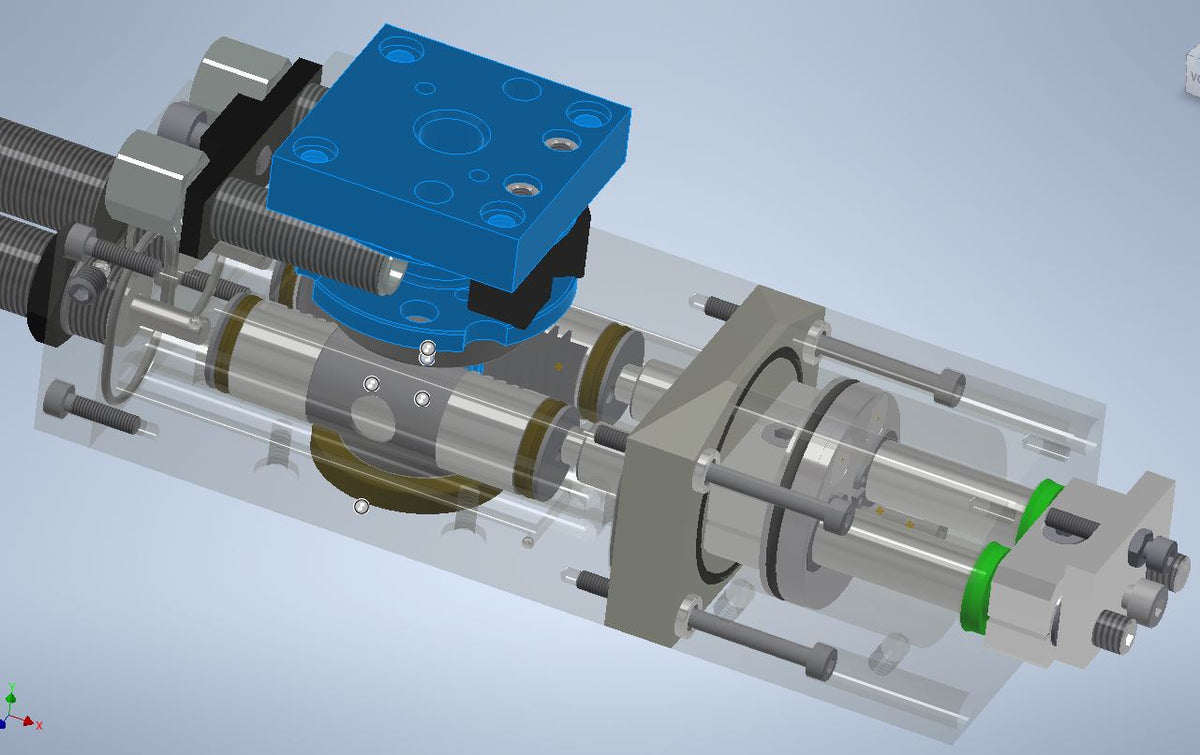
Intermediate positions for swivel units Tips and tricks
Module "Intermediate position" brings third position to swivel unit
Read more
Watch animations